Volume 8, 2026 Edition
What you will find:
• The Constitution says “Innocent” – Act 30 says “May”. The Battle for Bail in Ghana.
• Let the Republic Earn the Right to Detain: Flipping the Burden under Article 19(2)(c).
• One Country, Two Laws. “When justice appears harsh against the weak but accommodating towards the powerful, confidence in the law suffers.” When justice appears harsh against the weak but accommodating towards the powerful, confidence in the law suffers.” – Samson Lardy Anyenini.
• An innocent man does not beg. Bail is not a favour from the State. It is a right from the Constitution.
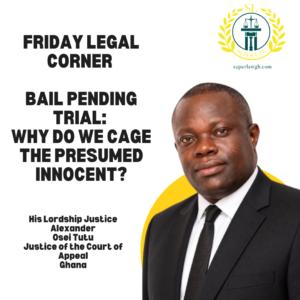
BAIL PENDING TRIAL: WHY DO WE CAGE THE PRESUMED INNOCENT?
“Rethinking the Burden of Proof for Bail under Article 19(2)(c) of the 1992 Constitution.”
Abstract
Ghanaian criminal procedure proclaims the presumption of innocence under Article 19(2)(c) of the 1992 Constitution, yet at the point of bail pending trial, practice inverts that presumption. The accused is required to justify his entitlement to liberty.
This article examines the statutory framework under Section 96 of the Criminal and Other Offences (Procedure) Act, 1960 (Act 30) and relevant jurisprudence, particularly Martin Kpebu (No.1) v Attorney-General.
Before Martin Kpebu (No.1) v Attorney-General , serious offences such as murder, treason and robbery under Section 96(7) of Act 30 were non-bailable. In Martin Kpebu (No.1) v Attorney-General , the Supreme Court declared Section 96(7) unconstitutional and held that all offences are bailable.
The article argues that despite Martin Kpebu v. A-G, pre-trial detention continues to be the de facto punishment for persons arrested and charged. The burden still lies on the accused person to justify why he deserves bail. This defeats the presumption of innocence. Drawing on comparative models from the UK Bail Act 1976, the Kenyan Constitution and the Seychelles Constitution, they argue that the presumption of innocence is not a mere principle, but a right that must include a presumption in favour of bail. It proposes a statutory presumption in favour of bail, shifting the burden to the Republic to demonstrate substantial grounds for detention.
It further examines the recent policy announcement by the Honourable Attorney-General to deploy lawyers to police stations to assist suspects, and argues that while laudable, the initiative will only achieve its constitutional objective if the law is amended to make bail a right and refusal an exception. It further critiques onerous bail conditions and uses Thomas Teye Partey case to illustrate pre-conviction prejudice.
1. Introduction
In criminal law, we recite a sacred creed with almost religious encomium that a person is presumed innocent until proven guilty. As criminal law boilerplate, the presumption has been consistently invoked, but rarely analysed. It is enshrined in Article 19(2)(c) of the 1992 Constitution, affirmed by Article 11 of the Universal Declaration of Human Rights, adopted by Article 7(1)(b) of the African Charter on Human and Peoples Rights and immortalised by Lord Sankey in Woolmington v. Director of Public Prosecutions as the golden thread that runs through the tangled web of the English criminal law. Blackstone’s ratio that it is better for ten guilty persons to escape than for one innocent person to suffer underpins this creed. This is found in every first-year criminal law textbook.
Yet, at the very first gate where the accused person meets the muscular State for the trial, we quietly almost strip him of that very presumption. Like a man asked to surrender his own coat before he is proven guilty of stealing it, we ask the presumed innocent man to undress his innocence and beg for his freedom.
Wait. If the accused person is truly presumed innocent, why does he have to beg for bail in order to be free? Why must liberty be supplicated as if it were alms from a chief’s palace, and not asserted as a right like a birthmark? Why must a man, cloaked by the Constitution in innocence persuade the court that he deserves liberty? Should it not rather be the Republic that must convince the court why the liberty of an accused man should be denied him?
This is the unspoken, uncomfortable paradox of criminal procedure. The golden thread becomes a frayed rope. The burden to prove an entitlement to bail rests on the accused. That procedural reality quietly defeats the lofty constitutional promise of innocence.
This article argues that Ghanaian bail jurisprudence has incestuously conflated pre-trial liberty with post-conviction punishment and proposes a radical reversal of the burden.
2. The Current Practice: Detention as Default – The Inverted Pyramid
In our courts today, the architecture of criminal procedure is not a temple, but an inverted pyramid – a grotesque, tottering structure that balances its entire weight on a single, sharp, narrow point: detention. The foundation is the sky, the point is the dungeon.
When a man is charged, the court’s reflex and muscular posture is to cage him first and ask questions later. After the plea, and after the rehearsed facts are read like a dirge, the presumed innocent man must, through counsel, limp to the bench and move the court for bail. He must give an assurance of a fixed place of abode as if homelessness is synonymous with guilt, as if a kiosk dweller cannot be innocent. He must promise not to interfere with witnesses, as if his very breath were interference. Most painfully, he must conjure persons of substance – with landed property and title deeds, to vouch for him, as if freedom were a mortgage to be underwritten. It is as if liberty were a land transaction at the Lands Commission.
If the accused fails this Herculean, classist obstacle race, he remains in custody. Weeks. Months. Sometimes wasted years before a single witness is called. The docket gathers dust and sleeps in a filing cabinet while the accused person rots, wilts and withers in custody. This practice turns logic, morality and the Constitution on their heads. It is akin to ordering a defendant in a land dispute to vacate the land he occupies before title is eventually determined, on the speculative ground that he might tamper with boundary pillars. If that sounds absurd in civil cases where proof is merely on a preponderance of probabilities, it should sound constitutionally bizarre, even obscene in criminal cases where the prosecution bears the golden, higher, heavier burden of proof beyond reasonable doubt.
The bail practice in Ghana is like giving a footballer a harsh red card before kick-off, because there is a speculation that he might commit a foul in the 90th minute. The presumption of innocence – that golden thread says: Lace your boots and play the beautiful game; if you foul, you will be punished. But our bail practice, inverted and impatient says: We suspect, we smell, that you will commit a foul, so go and sit alone, dejected, in the cold dressing room now and wait for the outcome of the match. We will decide your fate later – whether you committed a foul before kick-off or not.
The Korle Bu Amputation Analogy
Yet again, imagine you walk, hale and hearty, into the Korle-Bu Teaching Hospital for a routine medical check-up and the doctor at the outpatient department (OPD) examines you and declares you healthy. Then before any laboratory result, before any blood work, before any X-ray, before any clinical diagnosis, the same doctor looks you in the eye and says: “But we are going to amputate and cut off your leg now, just in case the lab test tomorrow shows you have cancer in the leg. If the test shows you are healthy, we will stitch it back for you.”
You would not call the doctor a healer. You would call him a butcher in a white coat. That is precisely what pre-trial detention does. It amputates liberty before the diagnosis of guilt. It cages it before conviction. It punishes the accused before proof. And like the amputated leg, liberty once severed and years lost in Nsawam can never be truly stitched back.
Lord Russell of Killowen CJ thundering in R v. Rose declared that bail is to secure the accused’s attendance, not to punish the accused. It is a rope, not a rod. Where bail is refused or subject to mountainous, impossible conditions because the offence is grave, it ceases to be a process and becomes a naked, unadorned pre-trial punishment offending the very soul of the presumption of innocence. This echoes the piercing truth of Prof. Ashworth that remand is a punishment without verdict and a prison term without trial.
3. It Defeats the Presumption – The Constitution Cannot Be a Fair-Weather Umbrella
The presumption of innocence is not a mere dusty trial rule, to be dusted off like an old wig when the prosecution opens its case. It is a grand constitutional attitude, a golden lens through which the State must view the frail citizen from the brutal moment of arrest to the glorious moment of acquittal. The presumption of innocence is not only a rule of evidence. As the luminary Deane J noted in Dietrich v The Queen, it is a living norm, a civilised norm that governs the humane treatment of the accused throughout the process.
When we place the crushing burden of justifying bail on the accused, we apply a dangerous and poisonous syllogism: You are the accused, therefore you are suspected. Because you are suspected, you are deemed risky. Because you are deemed risky, you must be caged. Therefore, prove that you are not dangerous.
It is a trial by suspicion. A trial by rumour. The accused is made to disprove conclusions that have not yet been proved, to fight shadows that have not yet taken shape. He must prove he will not abscond, when no court has found that he has anything to abscond from. He must prove he will not tamper with evidence, when the evidence has not even been disclosed to him. It is a pre-trial punishment – a premature, perverse punishment in advance of the verdict, like flogging a trembling schoolboy for failing an exam before the examination script is even marked.
The Constitution cannot be a fair-weather umbrella. It cannot be flamboyantly opened when the gentle trial sun shines in the lofty amphitheatre of our courtrooms, and then clinically folded, forgotten, and dumped in a corner, when the fierce howling storm of arrest and remand beats down mercilessly on the poor, bewildered citizen in a police station at 2 am or at a 6 pm on a Friday, so that the police can lawfully and sanctimoniously wave the 48-hour rule in the face of the hapless suspect and his counsel, while liberty waits till Monday.
If Article 19(2)(c) means anything and not a mere decorative poetry, it must mean this simple, seismic truth: that liberty is the rule; detention is the exception. Liberty is the main road; detention is the narrow detour. The ancient enduring Latin maxim remains unshakable: Ei incumbit probatio qui dicit, non qui negat – applied here, he who seeks to take one’s liberty from him (the mighty State that seeks to snatch freedom from the frail citizen) must be able to justify it, with cogent evidence.
What the Law Says
a. Constitution, 1992:
– Article 19(2)(c) – Every person charged with a criminal offence shall be presumed innocent until proved guilty or has pleaded guilty.
– Article 19(11) – A person shall not be convicted of a criminal offence unless the offence is defined and the penalty for it is prescribed in a written law.
– Article 14(1) – No person shall be deprived of his or her personal liberty except in accordance with procedures established by law.
– Article 15(1) – The dignity of all persons is inviolable.
b. Criminal and Other Offences Procedure Act, 1960 Act 30:
– Section 96(1) – A court may grant or refuse bail and may set conditions. The wording is discretionary.
– Section 96(3) – The bail conditions to be fixed must have regard to the circumstances of the case and must not be excessive or harsh.
– Section 96(4) – Bail is not to be withheld or withdrawn as a punishment.
– Section 96(6) – Lists factors: nature of offence, strength of evidence, likelihood of interfering with witnesses, etc.
– Section 96(7) – Formerly prohibited bail in cases of treason, murder and certain offences.
Section 96(7) originally imposed a blanket ban on bail for treason, murder, hijacking, robbery and other offences. It was a legislative iron curtain. This curtain was torn down in Martin Kpebu (No.1) v Attorney-General. The Supreme Court held that such wholesale prohibition violates Article 19(2)(c) and Article 14. Bail is integral to a fair trial. It is not a footnote to fair trial; it is its heartbeat.
Despite the luminous ratio in Martin Kpebu, the old practice stubbornly persists. The accused, often a poor, frightened man, files a humble affidavit that he has a fixed place of abode at Achiase; that he will not abscond; that he has willing sureties and that he will appear at the trial. The Republic, mighty and well-resourced, often opposes by repeating familiar phrases: “the offence is serious”, “investigations are ongoing”, “he may interfere with witnesses”. No evidence. Just incantations.
Let us say it plainly and loudly: Under Articles 14 and 19, bail is a constitutional right, not a favour or indulgence.
4. What the Law Should Be – Bail as a Right, Not Indulgence
A system truly faithful to the presumption of innocence would state the rule in unambiguous terms, without apology: A person charged with an offence – whether a trotro driver, market woman, or a former Minister is entitled to bail as of right, unless the prosecution proves with substantial evidence, why he should not be entitled. The prosecution must not merely allege risk; it must prove risk and nail risk to the wall. That there is a real, substantial risk that the accused will not appear, will interfere with investigations, or will commit further grave offences, and that no condition – whether reporting at dawn, a surety with title deeds or passport surrender – can contain that risk.
This is not radicalism. It is constitutionalism. It is orthodoxy. Properly construed, this is what Section 96 of the Criminal and Other Offences (Procedure) Act, 1960 (Act 30) envisages, and what our apex court affirmed in Martin Kpebu (No.1) v A-G. Bail is not a favour from the Bench; it is a right incidental to liberty. In Jonathan Mensah Ansah v. The Attorney- General & Anor., the Court of Appeal was explicit that bail is a fundamental human right guaranteed by Article 14 of the 1992 Constitution.
Think of it as a scale – the old scale of justice. On one side is Article 14 – the precious liberty of a citizen who has not been found guilty. On the other side is the Republic’s interest in securing attendance at trial. From the start, the scale tilts in favour of liberty. Liberty is the rule; detention is the exception.
It is for the prosecution to present compelling evidence to tilt the scale. The prosecution has all the machinery of the State – the police with handcuffs, the CID with dockets, the National Security with sirens, EOCO with freezing orders and the Attorney-General’s docket with its awesome seal. It is not for the accused to justify why the scale should not crush him. The accused often appears confused, frightened, unrepresented and standing in the dock for the first time.
The prosecution holds the sword and the shield. Let it also bear the burden. He who wields the power to cage must also bear the burden to justify the cage.
Currently, the burden is de facto but deadly. It is cast upon the accused. The applicant who is presumed innocent, must persuade the court that he deserves bail; as if liberty were a prize, not a right.
This is where it becomes troubling. The presumption of innocence demands the opposite. Ei incumbit probatio qui dicit, non qui negat – the burden of proof lies on him who asserts, not on him who denies. The prosecution must prove the guilt of the accused. This was laid down in Woolmington v. DPP and repeated in Miller v. Minister of Pensions. Ghana has applied it in Lutterodt v. Commissioner of Police and Brempong v. The Republic among others.
If innocence is presumed, liberty should also be presumed. If innocence is the cloak, liberty must be its lining. Detention should be the exception requiring rigorous, reasoned justification, not liberty. Liberty should never beg.
As the great Prof. Glanville Williams argued, with piercing eloquence in The Proof of Guilt: “To keep a man in prison before his guilt is proved is to inflict punishment without a verdict.” It is to inflict wounds without war.
5. Why Does the Burden Lie on the Accused? Examining the Justifications
a) “Bail is a privilege, not a right” – The Ancient Ghost
This is the old mindset – a dusty ghost from the English Middle Ages. In those days in England, pre-trial detention was cruelly anchored on the jaundiced view that allowing bail would discourage the King’s prosecution, that freedom would weaken the Crown. But Holt C.J. in the celebrated Anonymous case of 1698 viewed that reasoning as erroneous.
Indeed, the discretionary tone of Section 96 swayed many courts to see bail as grace. Under Section 96(7), bail was expressly denied for some serious charges. It was as if once a person is charged, he was guilty and had to begin to suffer incarceration. In The Republic v. Gorman & 5 Ors. , the Supreme Court, relying on Article 14(4) of the Constitution, treated bail as discretionary and not a privilege.
This view was, however, rejected in Martin Kpebu (No.1) v A-G. Section 96(7) was declared unconstitutional. Now, all offences are bailable. The statute was not allowed to swallow the constitutional guarantee under Articles 14 and 19(2)(c) as it had done for many years until the decision.
Benin JSC who delivered the lead judgment hammered on the presumption of innocence thus: “The principle of presumption of innocence is a very important one in the criminal justice system and it underpins the basic concept of individual liberty under the Constitution … the principle in favour of the accused is the undoubted law, axiomatic and elementary, and its enforcement lies at the foundation of the administration of our criminal law … the principle has gained worldwide acceptance. The UN Declaration of Human Rights, article 11(1) states that: ‘Everyone charged with a penal offence has the right to be presumed innocent until proved guilty according to law in public trial at which he has had all guarantees necessary for the defence.’ The same principle is re-stated by article 7(1)(b) of the African Charter on Human and People’s Rights. Article 19(2)(c) reaffirms this principle which Ghana has subscribed to at both the UN and AU.”
Martin Kpebu supra thus made bail a right and not a privilege in Ghana. The Indian Supreme Court agreed in Mahesh Kumar Agarwal v. Union of India & Anor. that liberty is not a gift from the State.
b) “The accused knows best why he will not abscond” – The Practical Fallacy
This argument sounds practical and pragmatic, but it is flawed. The prosecution also has information – in fact, better information. It has access to criminal records, investigation reports and prior warrants, as well as information about the seriousness of the offence. The State has the docket, the database, the diary.
In the US, under the Bail Reform Act 1984, and in the UK under Section 4 of the Bail Act 1976, there is a presumption in favour of bail and the prosecution must show, with hard evidence, “substantial grounds” to detain. The burden is on Goliath, not David.
c) “To prevent crime and protect witnesses”
These are valid reasons, but they should not reverse the burden. Fear is not evidence. The prosecution must lead cogent evidence to show that detention is truly necessary, not merely convenient. As the European Court of Human Rights held in Neumeister v. Austria, pre-trial detention must be justified by “relevant and sufficient reasons” shown by the State.
The State must show its cards, not hide behind the shadows.
d) The Seidu v. The Republic and Owusu v. The Republic Error – Judging Guilt by Paper
In cases such as Seidu v. The Republic and Owusu v. The Republic , bail in murder cases was decided by considering whether the summary of evidence disclosed no proper murder charge. The Court of Appeal in Abdul Samed Seidu v. The Republic. , per Kusi Appiah J.A. questioned this approach.
At that stage no evidence has been adduced, no witness has been sworn and no cross-examination has taken place. The charge is a mere allegation – a paper tiger. It is what the prosecution says it will prove, and not what it has proved. As His Lordship stated with unforgettable clarity: “Any decision by the trial Judge based on the summary of evidence before trial will be wrong.” It is wrong because it is premature, prejudicial and presumptuous.
Taylor J in Okoe v. The Republic held thus: “To suggest that a man is to be incarcerated for anticipated but unconsummated crime is a suggestion that I find a little difficult to appreciate.”
To cage a man because the charge sheet states “murder” or “robbery” is to presume guilt from the accusation itself. It is hanging the man before hearing him. If seriousness on paper were enough, bail would never be granted for serious offences and Martin Kpebu (No.1) v A-G. which makes all offences including murder bailable would be rendered nugatory.
What must be shown, per Martin Kpebu and Article 18(7) of the Seychelles Constitution, is not the seriousness of the charge, but the necessity for detention.
6. Does It Defeat the Presumption of Innocence? Yes. Emphatically Yes.
Criminal jurist Andrew Ashworth in The Criminal Process argues that pre-trial detention is the most powerful, public and damning statement that the system believes you are guilty. The accused sits on remand, often in the dark, overcrowded cells of Nsawam or Ankaful, for months or years, while the prosecution “investigates”. He is not convicted, yet he is caged.
He loses his job. His reputation rots. His family suffers and breaks apart. His children drop out of school. His wife is stigmatised. And if he is later acquitted, who restores him? Who gives back his lost years? No one. The State says, “sorry” with silence.
A prolonged remand without bail is therefore considered unconstitutional, cruel and corrosive. It violates the maxim Nemo debet bis vexari – no one should be punished twice. Pre-trial detention is punishment before a verdict. It is a sentence before trial. It is the Constitution that is being beaten by procedure.
It is sad to observe that the procedure requiring a presumptively innocent citizen to justify his liberty quietly turns the presumption of innocence into a presumption of guilt. This makes bail the exception and freedom, a favour.
7. Comparative Lessons
UK: Bail Act 1976, section 4 creates a golden presumption in favour of bail. The burden is put on the prosecution. The prosecution must show solid grounds that the accused will abscond, will commit an offence, or will interfere with investigations. Bail is the rule; detention is the exception.
Kenya: Article 49(1)(h) of the 2010 Constitution — An arrested person has a right to be released on bond or bail, on reasonable conditions, pending a charge or trial, unless there are compelling reasons not to release. The burden is cast on the State to show those compelling reasons.
Seychelles: Article 18(7) of the Constitution provides that all offences are bailable in principle. The burden is on the prosecution to prove why pre-trial detention is necessary.
Painfully, Ghana therefore lags behind despite the progress made by the Supreme Court in Martin Kpebu v. A-G supra. We have the words of liberty, but we practise the culture of confinement.
8. The Cost – Remand Prisoners and the Two-Tier Presumption
When we make the accused beg for bail, when we make him kneel for freedom, we harvest what we sow: prisons become bloated, bursting with the legally innocent. The Nsawam gate groans.
In Ghana, the Justice for All Programme reveals hundreds languishing on remand for years without trial. It is no wonder that per the records, remand prisoners alone could constitute thirty percent (30%) of the prison population. Some spend three (3) to five (5) years on remand, sometimes even exceeding the maximum sentence for the offence with which they are charged, and are eventually acquitted.
Worst of it all, there is no compensatory regime for remand prisoners. Article 14(7) of the 1992 Constitution creates a paradoxical hierarchy of victims. It compensates the person who was convicted, sentenced and later acquitted on appeal, yet it cruelly abandons the person who was never convicted at all. The remand prisoner who spends years in lawful custody under Article 14(3) and is subsequently acquitted at trial falls through a constitutional blind spot, a black hole. His detention was lawful, so Article 14(5) cannot help him, and because he was never sentenced, Article 14(6) is irrelevant. He has served time without a sentence, and been punished without guilt, yet the Constitution offers him no certificate to the Supreme Court, no remedy, no reparation.
If compensation is due where the State was wrong after conviction, how much more is due where the State was wrong before conviction, when the presumption of innocence was still at its peak, still pristine?
Men and women presumed innocent under Article 19(2)(c) of the Constitution, are made to sleep on bare concrete floors. They lose their jobs, families and reputations. Some contract infectious diseases in overcrowded cells. All this, simply because they cannot produce landed documents.
We have created a two-tier presumption of innocence: one for the propertied, another for the poor. The businessman with two title deeds buys his presumption back by lunch. The trotro driver, the okada rider, the head porter who rents a kiosk, cannot. Both are presumed innocent by the Constitution; in reality only one is presumed innocent in the cells. This is justice as an auction – liberty to the “highest bidder.” And a presumption that can be bought is no presumption at all; it is a privilege.
This cost is precisely what counsel Samson Lardy Anyenini recently decried when he observed, with righteous anger, that there seem to be two laws operating in Ghana, one soft, silken law for the rich and powerful, and one hard, harsh law for the poor, the trotro driver, the market woman.
He put it in words that deserve to be framed: “When justice appears harsh against the weak but accommodating towards the powerful, confidence in the law suffers. Justice must be firm without being cruel, merciful without being selective, and equal without regard to status. One country, one Constitution, one standard of justice.”
The sad reality is that some courts still impose bail condition that sureties must be civil servants earning not less than a stated amount. If the accused, a cocoa farmer from Sefwi or a fisherman from Axim, has no family relation who is a civil servant, he languishes on remand. His continuous detention is then not based on the risk of absconding or interference, but on poverty and the lack of social capital. The Constitution does not say Article 19(2)(c) is for civil servants’ relatives. It says it is for every person.
The prejudice of pre-trial detention is not confined to our cells. The case of Black Stars midfielder, Thomas Teye Partey, charged in England with an alleged rape and other sexual offences, is illustrative. Though charged and not convicted, and therefore presumed innocent under English law as under Article 19(2)(c) of our own Constitution, the reported denial of a Canadian visa during the World Cup period sparked public outcry in Ghana. The public instinct was correct. To deny a man opportunities, visas, and livelihood on the basis of a charge that is yet to be proved is to punish him before verdict. It is to make the charge itself the conviction. That is precisely what our bail regime does every day to the trotro driver in Kaneshie.
It must be emphasised that this critique is not of any particular government regime or Attorney-General. The inversion of bail from right to privilege is a systemic colonial hangover that has survived every government since independence, military and civilian, First Republic to Fourth Republic. It is a problem of the statute book, Section 96 of Act 30, not of any administration. It has lived through all colours of government.
As Justice Hugo Black said in Griffin v. Illinois : “There can be no equal justice where the kind of trial a man gets depends on the amount of money he has.”
It is in that context that the Hononurable Attorney-General’s recent commendable announcement to attach lawyers to police stations must be understood and examined. Under a 24-hour economy, the lawyer may indeed meet the trotro driver at 2 am in the cold cells of Nima or Asafo. But if Section 96 of Act 30 still says, “may” grant bail, and bail conditions still require “title deeds”, “landed properties” and four sureties, the lawyer becomes a helpless witness to the auction, not a cure for it; a spectator at the sale of liberty, not its saviour. We would have succeeded only in institutionalising a system in which lawyers watch the daily, nightly violations of Article 19(2)(c).
True justice at police stations requires not just the presence of counsel, but the presumption of liberty. The lawyer should not beg, should not kneel, should not bargain. Under the proposed model, he should be able to stand and remind the police, with constitutional confidence: “My client is entitled to bail under Section 4 of the UK Bail Act model, unless you can show substantial grounds to detain him.” That is what Section 4 does. That is what Kenya does. That is what Seychelles does. That is what Ghana must have.
9. The Way Forward: Flipping the Burden – De Lege Ferenda
I propose a reform, a bold, constitutional reform, de lege ferenda:
a. Presumption in favour of bail: As in the UK Bail Act 1976, every accused person is entitled to bail as of right unless the prosecution shows cause why bail must not be granted.
b. Burden on the prosecution when opposing bail: The prosecution must file an affidavit, not merely an oral whisper, showing substantial grounds – a real risk of absconding, a real risk of interference, a real risk of committing further offences – with evidence.
c. The court must give written reasons for the refusal of bail: A refusal without reasons may implicitly violate Article 19(2)(c).
d. Proportionality test: Detention must be necessary and proportionate, with no less restrictive measure that would suffice. It must be the last resort, not the first reflex.
e. Amend Act 30: Section 96 must be amended to read: “Every person charged with an offence shall be granted bail unless the prosecution provides substantial grounds to the court that detention is necessary.” One sentence and the burden somersaults.
f. Substantial grounds limited to three: (a) the failure to appear to stand trial, (b) interference with the prosecution’s witnesses or evidence, and (c) the commission of serious further offence.
g. Time Limit: There must be an automatic bail review every 28 days for remand prisoners. Liberty cannot be left to rot in a file
These measures would align with Article 19(2)(c) and make punishment start after verdict, not before. They will make sentencing follow trial, not precede it.
10. Conclusion: Let the Republic Earn the Right to Detain
Bail pending trial tests our fidelity to the presumption of innocence. If we believe a man is innocent until proven guilty, we must act like it from day one. Bail should not be pleaded for like charity before a chief. Let liberty stop begging.
The courtroom is a theatre of justice. It is a sacred theatre. But when we make the accused person stand in the dock, in rusted handcuffs, to beg for what the Constitution has already given to him, we make a mockery of that theatre and turn justice into a rehearsed lie.
The prosecution brings charges. The Republic brings the accusation. Let the Republic earn the right to detain. Let the Republic justify why, before conviction, a citizen should lose his freedom. Until it does, with cogent and compelling proof, the accused must remain free – working, providing, preparing his defence as an innocent man should, as the Constitution says he is.
As held by the High Court in Okoe v. The Republic and affirmed by the Court of Appeal in Jonathan Mensah Ansah v. the Republic, the presumption of innocence under Article 19(2)(c) is not a polite language. It is a constitutional right. It is not a courtesy. It is not a cliché. It is a command. And if it is a right, then bail flowing from it must also be a right.
Otherwise, the presumption of innocence remains what it has become in too many courtrooms in Ghana, from Kaneshie to Aflao, Wa to Axim: a beautifully framed Article 19(2)(c) we often hang on the wall of the courtroom during trial, while beneath it, the accused stands in a cage we built before we read what the frame says.
An innocent man does not need to plead to be free. An innocent man does not beg.
It is time for Ghana, as regards bail, to shift the burden where it belongs – on the State, where the Constitution put it.
Fiat justitia ruat caelum – Let justice be done though the heavens fall.